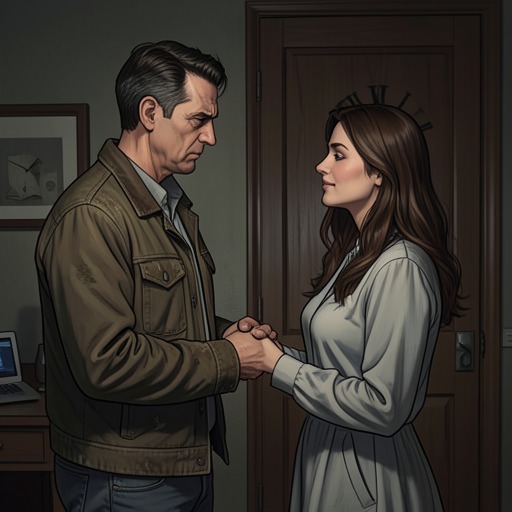
Paul Rayley’s proposal to Minta Doyle
To the LighthousePaul Rayley’s proposal to Minta Doyle is a turning point whose emotional force lies in the gap between its outward form and Paul’s inward alarm. After seeing the couple kissing and joining them in a frantic search for Minta’s lost brooch, Nancy and Andrew return to the house without knowing what has passed between them. Paul, however, experiences the proposal as the worst moment of his life, even as he imagines marriage, children, and a shared future. At dinner, Minta’s manner and Paul’s first use of “we” allow Mrs Ramsay to recognize that the proposal has been accepted. The scene makes the engagement both a romantic beginning and an uncertain leap into a future the lovers can only imagine.
Background and the beach encounter
On the shore, Nancy is absorbed in the tidal pool, transforming its minnows into sharks and whales in her imagination, when Andrew calls that the sea is coming in. She leaps through the shallows and runs behind a rock, where she unexpectedly finds Paul and Minta in each other’s arms, probably kissing. Shocked and indignant, she and Andrew say nothing about what they have seen. Their silence does not resolve the encounter; it leaves them awkwardly conscious of it, and each becomes irritated with the other. Andrew resents that Nancy is a woman, while Nancy resents that Andrew is a man, as though the scene has made the difference between them newly conspicuous.
The lovers’ private moment is immediately overtaken by Minta’s discovery that her grandmother’s brooch is missing. It is a weeping-willow ornament and the only piece of jewelry she owns, fastened to her cap by her grandmother until the last day of the older woman’s life. Minta would rather have lost anything else. Everyone turns back to search, bending low and peering among the rocks; Paul searches frantically where they had been sitting. But the tide is advancing, and the place will soon be covered. When Minta cries that they will be cut off, Andrew thinks her terror resembles an earlier episode with bulls and judges that she cannot control her feelings. Paul tries to comfort her, while he and Andrew take charge of what can still be done: they plant Paul’s stick at the spot and agree to return at low tide.
Nancy senses that Minta is crying for more than the lost ornament, though she cannot say what the additional sorrow is. The brooch gives the scene a material focus for a feeling that remains partly unspoken: the couple’s intimacy has been exposed, Minta has lost something precious inherited from her grandmother, and the search cannot recover it before the sea covers the place. The scene does not explain the proposal as a direct consequence of the loss. Instead, its mishap and emotional disturbance form the immediate setting for the couple’s altered relation.
The proposal and Paul’s imagined future
As Paul and Minta walk ahead together, he comforts her by telling her he is famous for finding things. He recalls finding a gold watch as a boy and assures himself that he can find the brooch. If he cannot, he privately resolves to slip out at dawn while the household sleeps and buy Minta another, more beautiful one in Edinburgh. Minta says she will not allow him to get up early; she believes the brooch is lost and remembers having a presentiment when she put it on. Paul keeps his plan to himself. His determination to repair the loss becomes part of his private effort to prove what he can do for her.
The narrative then reveals that the proposal has already taken place, without first presenting it as a triumphant declaration. Paul imagines the lights appearing one by one below the hill as signs of what may come: his marriage, his children, his house. He pictures the two of them withdrawing into solitude together, with himself leading and Minta pressed close to his side. Yet this expansive vision is balanced by his memory of how terrible it felt to ask her to marry him. He thinks it was “far and away the worst moment of his life.” The future appears to him as a sequence of desired domestic images, but the act that makes that future possible has left him shaken.
Paul decides that he must tell Mrs Ramsay what he has done. He believes she made him feel capable of taking the step: she had followed him with her eyes through the day, and he had understood her look as confidence in him. In his imagined report, he will tell her, “I’ve done it, Mrs Ramsay; thanks to you.” His gratitude makes the proposal more than a private exchange between the couple. Mrs Ramsay’s influence has helped authorize Paul’s confidence in himself, though she has not spoken the encouragement he attributes to her. As the party approaches the brightly lit house, he repeats “Lights, lights, lights” in a dazed way, then checks himself: “I must not make a fool of myself.” The excitement of imagining his future is already shadowed by his fear of appearing ridiculous.
Recognition at dinner
Paul and Minta arrive late to the dinner party with a maid carrying the great dish. Minta tells the assembled company that she has lost her grandmother’s brooch, her lament and tear-bright eyes drawing a teasing, chivalrous response from Mr Ramsay. She is not as intimidated by him as she once was: after an earlier conversation about George Eliot in which she feared he would discover that she had left the third volume of Middlemarch on a train, she learned to present herself as more ignorant than she was because he liked to call her a fool. Tonight, his teasing does not frighten her.
Mrs Ramsay reads Minta’s changed manner as evidence that the proposal has succeeded. Minta has what the narration calls her “golden haze,” a quality she recognizes in the way a man looks at her. Seeing her smile beside Mr Ramsay, Mrs Ramsay thinks the lovers are engaged. The realization brings her, unexpectedly, a moment of jealousy. She remembers that Mr Ramsay has been drawn to lively young women like Minta, whose wildness and richness differ from Lily Briscoe’s spare appearance and from Mrs Ramsay herself. Her response is mixed: she feels a little resentment at having grown old, yet she is grateful that the young women can tease Mr Ramsay into seeming youthful and attractive again. The engagement is thus registered not through a public announcement but through Minta’s bearing and Mrs Ramsay’s alert reading of the room.
Paul’s account of the search confirms the change for Mrs Ramsay. Sitting beside her, he says, “We went back to look for Minta’s brooch.” She hears the effort in his voice as he says “we” for the first time. The small pronoun carries a larger consequence: Paul now speaks of their actions as shared, and Mrs Ramsay imagines that they will use that language throughout their lives. The brooch remains lost, but the story of looking for it has become the first account Paul and Minta can tell as a pair.
A private decision made social
The dinner gives the engagement a communal setting without turning it into a formal ceremony. The candles draw the faces around the table together, and Mrs Ramsay has already felt that the company is making a party against the fluid darkness beyond the windows. Paul and Minta enter into that gathering carrying the immediate history of their walk: the kiss, the missing heirloom, the search, and their new sense of being together. Their lateness and Minta’s account of the brooch bring that history into the room, while the relationship itself is conveyed indirectly, through her ease and Paul’s “we.”
Mrs Ramsay’s response is both celebratory and clear-eyed. She thinks of the love between a man and a woman as serious, commanding, and carrying the seeds of death; at the same time, she sees these young lovers as entering an illusion with glittering eyes, suited to mockery and garlands. The mixed judgment prevents the engagement from becoming a simple promise of happiness. Its promise is real, but it is also an imagined future, vulnerable to time and to the losses already gathering around the characters. The dish of boeuf en daube, which has taken the cook three days to prepare, becomes the meal Mrs Ramsay associates with the occasion. She carefully chooses a tender piece for William Bankes, while the dinner’s shared abundance gives the private engagement a place in the life of the household.
That household context also reveals Mrs Ramsay’s wider role as an organizer of care and connection. She worries about the responsibilities she has assumed toward Minta’s parents and about Minta’s freedom to roam with Nancy; she knows that her matchmaking and interference have led one woman to accuse her of robbing a daughter of her mother’s affections. Yet Mrs Ramsay does not see herself as domineering. Her strong interventions, as she understands them, concern practical needs such as hospitals, drains, and clean milk, while her attention to Minta brings social and emotional obligations into the same field of care. Paul’s belief that Mrs Ramsay enabled him to propose and her recognition of the engagement at dinner show how her influence works: not by delivering the proposal for him, but by helping him imagine that he can act.
Significance and limits of the moment
The proposal is narrated through effects and recollections rather than as a fully staged exchange. Its decisive act is displaced into Paul’s inward account of its difficulty; the reader encounters the couple’s changed status through the future he imagines, Mrs Ramsay’s inference, and the word “we” at dinner. This structure preserves a difference between what Paul has done and what he can confidently feel about it. He imagines marriage, children, and a house, but also remembers the proposal as terrifying and worries about making a fool of himself. Minta’s composure offers another register of the change, without erasing her grief over the brooch or establishing what she thinks about the future in the same detail.
The scene therefore joins romance to uncertainty rather than treating engagement as a settled happy ending. Paul’s decision turns a kiss into a possible shared life, and Mrs Ramsay’s encouragement helps make that choice imaginable. But the couple’s future is presented through expectation, not through proof of lasting contentment. At the table, the first “we” marks a genuine alteration: two people begin to describe themselves as acting together. The lost brooch, the advancing tide, the trembling effort of Paul’s speech, and the lights he repeats on the walk home remain beside that hopeful pronoun, giving the new bond both its brightness and its fragility.